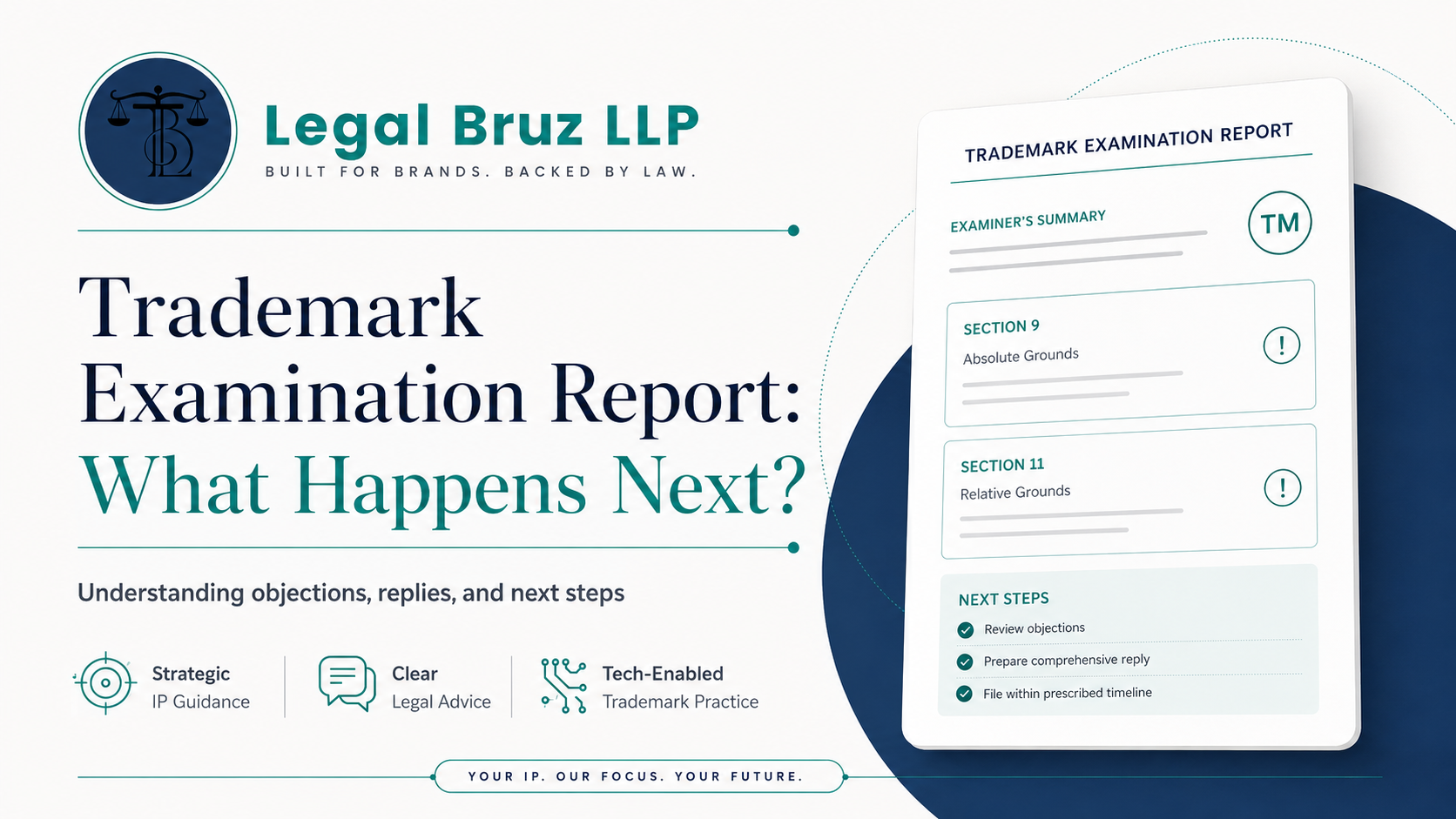
Receiving a trademark examination report does not mean that your trademark application has been finally rejected.
An examination report is issued when the Trade Marks Registry examines an application and identifies an objection to its acceptance, or proposes that the application should be accepted subject to certain conditions, amendments, modifications or limitations.
Under Rule 33 of the Trade Marks Rules, 2017, the Registrar examines the application and also conducts a search for earlier trademarks that may be identical or deceptively similar in relation to the same or similar goods or services. Where an objection arises, it is communicated to the applicant through an examination report.
In practical terms, the examination report is the Registry telling the applicant:
“We have identified an issue with this application. Explain why the trademark should nevertheless proceed.”
The next step is therefore not to panic, but to understand exactly what objection has been raised and why.
What Is a Trademark Examination Report?
After a trademark application is filed, it undergoes examination by the Trade Marks Registry.
The Registry considers whether the application complies with the Trade Marks Act, 1999 and the Trade Marks Rules, 2017.
The official IP India workflow shows that substantive examination commonly involves Sections 9, 11 and 13 of the Trade Marks Act. Where objections are raised, an examination report is issued. The applicant may then file a response, following which the Registry may either accept the application or schedule a show-cause hearing.
The examination stage therefore sits between:
Trademark application filed
and
Trademark accepted for publication
An application that receives an examination report has not yet failed. It has simply reached a stage where further legal or factual submissions may be required.
Why Has My Trademark Been Objected To?
Trademark objections can arise for several reasons, but two of the most common substantive objections involve:
Section 9 of the Trade Marks Act
These are generally referred to as absolute grounds for refusal.
They concern the inherent nature of the trademark itself.
Section 11 of the Trade Marks Act
These are generally referred to as relative grounds for refusal.
They concern conflicts with earlier trademarks.
Sometimes an examination report may contain objections under both provisions.
Understanding which objection applies is important because the strategy for responding to a Section 9 objection can be substantially different from responding to a Section 11 objection.
Section 9 Trademark Objection
A Section 9 objection typically concerns whether the proposed trademark is sufficiently distinctive to function as a trademark.
For example, an objection may arise where the mark is considered:
- devoid of distinctive character;
- descriptive of the characteristics of the goods or services;
- customary in the current language or established practices of trade; or
- otherwise affected by one of the absolute grounds contained in Section 9.
Consider a simplified example.
Suppose an applicant seeks registration of:
“FAST DELIVERY”
for delivery services.
The Registry may question whether those words merely describe the nature or quality of the service rather than identifying one particular commercial source.
A response may therefore need to address issues such as:
- whether the mark is genuinely descriptive;
- whether the mark should be considered as a whole;
- whether the combination of words is distinctive;
- the particular goods or services covered;
- prior use of the mark, where relevant; and
- evidence demonstrating acquired distinctiveness, if applicable.
A generic reply saying:
“The mark is unique and distinctive.”
is usually much weaker than a response addressing the specific legal basis of the objection.
Section 11 Trademark Objection
A Section 11 objection generally arises because the Registry has identified one or more earlier trademarks that it considers identical or similar to the trademark applied for.
This does not necessarily mean that the marks are actually confusingly similar.
The applicant needs to examine the cited marks carefully.
Relevant considerations can include:
- visual similarity;
- phonetic similarity;
- conceptual similarity;
- overall commercial impression;
- nature of the respective goods or services;
- trade channels;
- consumers;
- differences between the specifications;
- distinctiveness of the common element; and
- other relevant circumstances.
For example:
BLUEFOX
and
BLUE FOX
may create different issues from:
BLUEFOX
and
FOXTECH
even though both examples contain a common element.
The analysis is therefore not simply:
“Do the marks contain the same word?”
Trademark similarity is generally more contextual.
This is why a Section 11 response should normally examine each cited trademark individually rather than using the same generic argument against every citation.
How Long Do You Have to Reply to a Trademark Examination Report?
This is one of the most important parts of the process.
Rule 33(4) of the Trade Marks Rules, 2017 provides that where an applicant does not respond within one month from the date of receipt of the examination report, the Registrar may treat the application as abandoned.
The distinction matters:
The rule refers to one month from receipt of the examination report.
Applicants should therefore check:
- the examination report;
- the date of communication;
- correspondence records;
- details of the authorised agent, where applicable; and
- the status of the application.
The Trade Marks Registry has historically issued abandonment orders where no response was received within the required period.
If you discover an examination report late, do not assume that the application can simply be ignored until convenient.
The procedural position should be checked immediately.
What Should an Examination Report Reply Contain?
There is no useful one-size-fits-all reply.
A proper response should address the actual objections raised in the examination report.
Depending on the case, a response may include:
1. Application details
The trademark application number, applicant name, class and trademark should be correctly identified.
2. Response to each objection
Each objection in the examination report should be addressed separately.
If the report contains objections under both Section 9 and Section 11, both should ordinarily be dealt with.
3. Legal submissions
The response should explain why the particular statutory objection should not prevent registration.
4. Factual background
Relevant facts concerning adoption, use, business activities or the nature of the goods/services may be important.
5. Analysis of cited trademarks
For a Section 11 objection, the response may need to distinguish the applicant's trademark from the earlier marks relied upon by the Registry.
6. Evidence
Where the applicant relies on prior use or acquired distinctiveness, supporting evidence may become significant.
Depending on the circumstances, evidence could include:
- invoices;
- advertising material;
- website records;
- packaging;
- sales information;
- promotional material;
- social-media evidence;
- marketplace listings; and
- other records demonstrating genuine commercial use.
The evidence required depends entirely on the objection and the facts of the particular application.
Should You Copy an Examination Report Reply From Another Trademark?
Usually, no.
This is one of the most common mistakes in trademark prosecution.
Two examination reports may both contain a Section 11 objection but still require very different responses.
For example:
Application A
may be objected to because of an almost identical earlier mark covering closely related goods.
Application B
may contain the same word as an earlier trademark but cover commercially different services.
The legal provision may be the same.
The factual analysis is not.
Similarly, evidence that is useful in one Section 9 matter may be completely irrelevant in another.
Templates can help with structure.
They should not replace legal analysis.
What Happens After You File the Examination Report Reply?
Once the response is submitted, the Registry considers it.
Under Rule 33(5), if the Registrar accepts the response, the application may be accepted and advertised under Section 20 of the Trade Marks Act.
The official IP India workflow broadly shows:
Examination report
↓
Reply filed
↓
Reply reviewed
↓
Either:
Acceptance
or
Show-cause hearing
Acceptance does not immediately mean final registration.
Ordinarily, the trademark proceeds to publication in the Trade Marks Journal.
Third parties then have an opportunity to oppose the application within the applicable opposition period.
If no successful opposition prevents the application from proceeding, the trademark may subsequently move towards registration.
What Happens If the Reply Is Not Accepted?
An examination report reply does not guarantee acceptance.
If the Registrar is not satisfied with the response, Rule 33(6) provides for an opportunity of hearing.
This is commonly referred to as a show-cause hearing.
At this stage, the applicant or authorised representative may have an opportunity to make submissions addressing the outstanding objections.
The Registry may thereafter:
- accept the application;
- accept it subject to appropriate conditions or limitations where legally permissible; or
- refuse the application.
The current IP India workflow expressly shows refusal as a possible outcome where objections are not overcome following the relevant process.
Does “Objected” Mean My Trademark Has Been Rejected?
No.
This distinction is important.
Objected generally means:
The Registry has raised an objection and requires the issue to be addressed.
Refused means:
The application has reached a stage where the Registrar has declined registration, subject to whatever further remedies may legally be available.
An objected application may still proceed to acceptance if the objections are successfully addressed.
Can an Objected Trademark Still Be Registered?
Yes.
An examination objection is part of the prosecution process, not necessarily the end of the application.
The Registry's own workflow provides for an examination report to be followed by a reply, review, possible hearing, acceptance and ultimately publication and registration where the requirements are satisfied.
Whether a particular application is likely to succeed, however, depends on:
- the trademark;
- the objections raised;
- earlier cited marks;
- specification of goods/services;
- factual background;
- evidence;
- legal arguments; and
- subsequent Registry proceedings.
Can You Change the Trademark After Receiving an Objection?
Only within limits.
Rule 37 of the Trade Marks Rules permits correction or amendment of an application through Form TM-M in appropriate circumstances, but an amendment cannot substantially alter the trademark applied for or substitute a new specification of goods or services that was not included in the original application.
So an applicant ordinarily cannot respond to a difficult objection by transforming the original application into an entirely different trademark.
This is one reason why trademark clearance and filing strategy matter before the application is submitted.
What Happens If You Ignore the Examination Report?
Ignoring an examination report can put the application at serious risk.
Under Rule 33(4), where the applicant fails to respond within one month from receipt of the examination report, the Registrar may treat the application as abandoned.
“Abandoned” is not the same as “objected.”
An objected application remains under prosecution.
An abandoned application has effectively ceased to proceed because the required prosecution step was not completed.
The Trade Marks Registry has issued orders applying Rule 33(4) where no examination response was filed within the stipulated period.
Applicants should therefore monitor trademark applications even after filing.
Filing TM-A is the beginning of the registration process, not the end.
Common Mistakes After Receiving a Trademark Objection
1. Assuming the trademark has been rejected
An examination report is not automatically a final refusal.
2. Waiting too long to respond
The response deadline is procedurally significant.
3. Copying another examination reply
Trademark objections are fact-specific.
4. Ignoring cited trademarks
A Section 11 reply should normally analyse the earlier marks identified by the Registry.
5. Making assertions without evidence
Where prior use or acquired distinctiveness is relied upon, evidence can matter.
6. Treating every objection identically
Section 9 and Section 11 objections involve different legal considerations.
7. Assuming registration is guaranteed after filing the response
The Registry may still require a hearing or maintain the objection.
When Should You Consider Professional Assistance?
Not every examination report is equally complicated.
Professional assistance may be particularly useful where:
- several earlier trademarks have been cited;
- the applicant's mark closely resembles an earlier registration;
- the objection concerns descriptiveness or lack of distinctiveness;
- substantial prior use needs to be established;
- evidence needs to be organised;
- the application concerns commercially important branding;
- the initial response has already failed;
- a hearing has been scheduled; or
- the applicant is unsure of the procedural deadline.
The commercial importance of the trademark should also be considered.
For a business whose brand name forms a central part of its goodwill, an examination objection is not merely an administrative inconvenience. It can affect the business's long-term brand-protection strategy.
Frequently Asked Questions
How long do I have to reply to a trademark examination report?
Rule 33(4) provides for a response within one month from receipt of the examination report. Failure to respond may result in the application being treated as abandoned.
Does “objected” mean the trademark is rejected?
No. An objection means the Registry has raised an issue requiring consideration. The application may still proceed if the objection is successfully addressed.
Can an objected trademark eventually be registered?
Yes. The official process provides for reply, consideration, possible hearing, acceptance, publication and ultimately registration where the application satisfies the applicable requirements.
What is the difference between Section 9 and Section 11?
Broadly, Section 9 concerns absolute grounds, including issues relating to the inherent registrability of the mark. Section 11 concerns relative grounds, principally conflicts with earlier trademarks.
Will there always be a hearing after filing an examination response?
No. If the response satisfies the Registry, the application may proceed to acceptance. Where the response is not considered satisfactory, the Registrar may provide an opportunity of hearing.
How long does the Registry take to decide after the reply?
There is no single reliable timeframe applicable to every case. Processing depends on Registry workload, the nature of the objections, whether further examination is required and whether a hearing is scheduled.
Can I file an examination report reply myself?
Applicants may deal with their application themselves, but the important question is not simply who uploads the response. It is whether the response properly addresses the statutory objection, cited trademarks, evidence and factual circumstances involved.
Key Takeaway
A trademark examination report should be treated as a legal and procedural stage in the trademark application, not as an automatic rejection.
The most important steps are:
- identify the exact objections;
- confirm when the examination report was received;
- check the applicable response deadline;
- analyse Section 9 and/or Section 11 issues;
- review cited trademarks where relevant;
- gather supporting evidence if required;
- file a reasoned response; and
- continue monitoring the application after submission.
If the response resolves the Registry's concerns, the application may proceed to acceptance and publication. If the objections remain, a show-cause hearing may follow.
How LegalBruz Handles Examination Report Matters
If a trademark application has received an examination report, the first step is to assess the objections rather than submit a generic response.
LegalBruz assists with examination-report matters including:
Section 9 objections
Section 11 objections
Review of cited trademarks
Preparation of examination-report responses
Supporting evidence and documentation
Trademark hearings and further prosecution
You can submit the application details and examination report through the LegalBruz portal for review.
Disclaimer: This article provides general information about Indian trademark procedure and does not constitute legal advice. Trademark matters depend on the facts, documents, applicable law and procedural status of each application.